27 March 2014

Thinking bit: Strip the (beauty) pressure


Our very good friend Smaranda (the one most responsible for the Inspirations e-book ) suggested that we share this here, and we salute the tip-off!

So, what this experienced and professional lady named Tracey Spicer is suggesting is... yes, taking it off! And not in pole-dancing-will-empower-you way, no. Instead it's about acknowledging how much time women (and men to some extent, yes, but that's a lesser order of magnitude) spend preparing their exteriors before they go and do things. And how many more things you can do if you decide to dedicate your time to things that actually bring pleasure, knowledge, fun, whatever...

The empowerment recipe here: rethink your time spent on grooming, ask why you do what you do and is it worth it, and then reclaim a bit of your utterly human freedom by shedding the unnecessary.

21 March 2014

Friday is the (Inspirational) Movie Night: HIV/AIDS in the big cinema

#inspirational movies 

Putting this under "inspirational" may be somewhat questionable. Movies that have HIV/AIDS as their central theme are not even expected to be inspirational (or uplifting). But in the light of the recent incomer into the genre - Dallas Buyers Club (2013, Jean-Marc Vallée) - a little, very critical round-up seems adequate. And all of those movies touch the activism theme, so they are relevant anyways.

While our all-time favorite still is Rent (2005), these do have some attractive points to it (and downsides too, unfortunately). Curiously enough, there's a decade between the release dates for all three while there are set pretty much around the same time, mid-eighties up to early nineties:

Philadelphia (1993, Jonathan Demme), the ultimate HIV/AIDS classic on the legal battle against discrimination. Has quite some real life inspiration.

Lessons learned: (a) privilege does not protect you from HIV, and (b) homophobia can be cured dealt with if empathy kicks in and if close contact / familiarity is established.

Lacks in the department of: women. Only at the background, and the whole battle for rights is fought among privileged men.


Angels in America (2003, Mike Nichols), the we-are-all-connected esoteric epic on sexuality, coupledome, love, and HIV.

Lessons learned: (a) privilege does not protect you from HIV, and (b) HIV affects also those that are themselves sero-negative but with their lives inter-weaved in those of PLWHA, an obvious truth, but beautifully depicted. Also, (c) you cannot pray away homosexuality. Nor mental health issues.

Lacks in the department of: spirituality. All the angels, prophets, ghosts thing goes from whimsical to annoying to just crazy at times.


Dallas Buyers Club (2013, Jean-Marc Vallée), the quite shitty movie with a pseudo-alternative HIV/AIDS narrative that just got 3 Oscars. Also inspired by an actual person. Caused a major stirring not only because of the overall sexism of the movie but because of Jared Leto - a cis-male - being cast to play a trans person, and about how he does that. 

Lessons learned: (a) heterosexuality (and homophobia) will not protect you from HIV, (b) homophobia is not cured dealt with just by lose contact / familiarity if no empathy can be activated, (c) the big pharma says is not always in your best interest, (d) traditional masculinites are bad for your health.

Lacks in the department of: women. Only at the background, and the whole battle for rights is fought among men. Women are the angry but passive doctor, nurses, and random people that men have sex with.

Other movies that we have talked about before where HIV drives some part of the plot are Kids (1995) and The Hours (2002).

07 March 2014

Friday is the (Inspirational) Movie Night: The Snapper (1993)

#inspirationalmovies 

This one has lots of early 1990's written all over. Unless you are really allergic to that aesthetics, you're in for a curious one. The basic plot of The Snapper (1993, Stephen Frears) goes as follows: in a working-class Irish neighborhood, the 20-something Sharon has got herself pregnant (sic!) without being in a relationship, and she decides to give birth while refusing to disclose who the father is.

What follows is a pregnancy movie with a high dosage of slut shaming by the community, Guiness-drinking while pregnant and no conversation what-so-ever about the fact that all of this unplanned mess could've been prevented with some basic latex accessories...

Nevertheless, what makes The Snapper worthwhile is the portrayal of the neighborhood and family dynamics, how those who love you accept you and your life despite not being 100% in favor of your choices (and your accidents) while, how you should do the obvious by loving and protecting your loved ones, and how haters do not matter...
And stay alert for the stigma still pushed onto pregnancies with nobody male responsible for them, ignoring the idea that you can have children on your own. Be it a premeditated decision, or something that just happened, there are authentic and valid choices taking place.

This will do the cheering up if you are feeling somewhat depressed after having seen the other drinking-while-pregnant movie, 17 Filles (2011).

02 March 2014

LaToya ♥ Being a Girl (and Girl to Girl is an amazing initiative!)

LaToya Lane is an activist in IPPF member association in Barbados, and recently - with the help of internets and many people who though that her ideas are worthwhile - have got the support to launch an innovative and much needed initiative that brings together business, agriculture and empowerment for young girls and women.

My Name is LaToya Lane and I enjoy reading, taking new courses, and listening to podcasts on business.

How did you start your work?

Its funny that you say work, because many people do not see volunteer as real work. I began my work with my local family planning association at the age of 17. I must say that when I began I never thought that it would have assisted me with such personal and professional growth. I have been able to move from the President of that association's youth arm (Youth Advocacy Movement Barbados) to Third Vice President on the Barbados Family Planning’s board of directors. I love working in the area of Sexual and Reproductive Health and Rights, and I am at my best when I am delivering information that could enrich someone else's life.

What makes you continue? Why are you still doing it?

I have come to realize that my impact or my reach may not be as large as I want it to be, but having the ability to assist people in making moves to change their behaviors one person at a time still counts for something. It is that ability to impact at least one person that motivates me now, the small changes I can help people make, as these will hopefully snowball into bigger life changes.

What is this your endeavor of yours "Girl to Girl" and what impact will it have?

Girl to Girl is a personal development program for young girls and women using agri­business as a uniting component. Girl to Girl will take 14­20 young women from across the island of Barbados, training them in the area of business, personal development and agriculture. It will allow these women, most who have no experience in farming, to grow a percentage of crop for their families/communities and the remainder will be sold in local markets to obtain further capital to sustain the project.

The world would be a better place if everybody would: ­ 
See To Sir, With Love (1967). ­
Listen... ­ lol.. how about if people learned to listen? ­
Read  ­ I WIll Teach You to Be Rich by Remit Sethi.
­Try ­ mentoring.

Before I'm 80, I'd like to write a book and start a youth home. 

Click to read the feature that Barbados Today did for the Girl to Girl project.

28 February 2014

Friday is the (Inspirational) Movie Night: Gone with the Wind (1939)

#inspirationalmovies 

"Why does a girl have to be so silly to catch a husband?"

OK, this one is a challenge, because you can interpret it both ways. You could argue that - as in the case of Dirty Dancing, for example - there's not much empowerment or feminism to be found in Gone with the Wind (1939). It's racist. It's androcentric. It's about a privileged girlie facing the world and looking for a man to shelter her from the reality.

But here comes the trick: she ends up having to do stuff for herself. On her own. And that is revolutionary. Well, especially for a Hollywood studio superproduction of 1939 and a novel (written by a woman, take note) describing realities of a Southern-belle suddenly thrown into a turmoil.

Our impulse for including Gone with the Wind among our suggestions come from this article in Spanish critical feminist magazine (google translate should be able to help you!). They ask the following question: how come that even people aware of all those shortcomings (when it comes to aspiring towards empowering feminist fiction) do find it inspirational and somehow - backwardly - groundbreaking?

Their answer goes along the lines of recognizing the qualities of the heroine. Because beyond the superficial persona that Scarlett puts up in order to - very strategically! - try to attract a good match for marriage there is strong person able to grow and overcome the loss of privilege and vanity. An additional credit has to be given for the courage to admit - although through pain and not by choice - that there is life beyond romance and coupledom. And to the conviction that "tomorrow is another day". Resilience, therefore.

By the way, reading the book is always a good idea, too.

21 February 2014

Friday is the (Inspirational) Movie Night: El laberinto del fauno (2006)

#inspirationalmovies

"A fairytale for grownups," some commentary said... well, fair enough! The plot El laberinto del fauno (2006, Guillermo del Toro) can be described as "a young girl is informed that she's a long lost elf princess, and that she has to complete three tasks in order to return to the kingdom of her origin". Sounds quite inoffensive, right? Sounds like a fun fairy-tale, suitable for all ages?

No. El laberinto del fauno is rated R for "graphic violence and some language", and is not suitable for small children. At all. Unless you really want to traumatize. The fantasy world del Toro depicts is dark, eerie and very visceral.
But the movie is good, it has a brave, self-emancipating girl protagonist, and we could stop here.

But El laberinto del fauno has a second layer of relevance. The movie is set in right after the Spanish Civil War, depicting guerrilla warfare and some of the choice women could make in this context: (a) trying to survive and not get involved in any political action; (b) enjoying the privilege (and avoiding hunger and danger) if their husbands happened to be part of the new regime; (c) assuming the imminent risk and take part into guerrilla movement, either in the woods or helping from outside; or (d) trying to protect themselves and their children by actively seeking protection of the fascists. While none of these are clear-cut or independent choices, you get to witness the whole spectrum of from adaptation to resistance. That's the special, feminist added value of this movie.

An additional reading on a (slightly) different war that was won by other people and women's destiny after the victory: An Ugly Carnival by Antony Beevor on the social and physical punishments that women accused of collaboration horizontale during the WWII were submitted to.

14 February 2014

Friday is the (Inspirational) Movie Night: Alice in Wonderland (1951; 2010)

#inspirationalmovies


A double treat. Now, obviously, there are some significant differences between Disney's Alice in Wonderland (1951) and Tim Burton's Alice in Wonderland (2010).

Disney's Alice is a family-friendly musical basically and only suffering depicted is Alice's existential anguish (+ cards/guards being carried away to be executed + the tension around the naive oysters + some cartoon-like violence). And you get singing/gossiping flowers, the adorable Dormouse, Dinah and the gullible oysters, the rather bipolar Caterpillar, etc...while the basic narrative could be "a girl wonders off and explores a bit". It's not as deep nor dense as the original books, but gives you a somewhat glamoured-up and coloured version of Alice-logic and Wonderland-logic.

Burton's version sequel of the classical story is much darker, much more violent and decisive... in the sense of bringing political power play, oppression, real insanity, death into the picture. The characters that were slightly off the hinge when Alice was young (read: in the books and the Disney movie) have gone quite awry and scary. And - as in most of the bring in the savior stories - Alice's duty (while nobody asked her if she wanted to have such) is to save their world/put the correct monarch in place.

The final verdict is as follows: Disney's Alice is a fun classic, an older and very white version of Dora the Explorer, about a girl enjoying her fantasy world; Burton's Alice is the over-and-over retold story of an unexpected child savior (see The Chronicles of Narnia, The Neverending Story, The Wonderful Wizard of Oz, among many others). The only perk is the fact that he has interwoven that with the Alice narrative and explored Carroll's fantasy world and its creatures. Therefore, you pretty much have to be familiar with the books or the 1951 movies (as the golden standard among all the Alice-films) to understand where Burton comes from.
The old one is much better and you should know it by heart (the whole thing on giving yourself useful advices while challenging the rules of those around you, speaking truth to power, trying to balance being polite and not putting up with BS). Burton's Alice is interesting mostly just for his fans. And, well, yes, due to the fantasy world being offered as an escape from dreadful existence as female in Victorian England.  


On a lighter note, here you have the tune & video that Pogo has made from Disney's Alice. The singing flowers and such.

24 January 2014

Friday is the (Inspirational) Movie Night: Spirited Away (2001)

#inspirationalmovies 


Spirited Away (2001, Hayao Miyazaki) goes into the same box as much of children's adventure. Like Dorothy or like Sarah, Chihiro finds herself in a situation that requires her to become a better person than she has been so far and a braver one, too.
And somewhat more like Baby, she's challenged to stand up for people she loves (with no sexual connotations though, this is a PG animation apt for children).

According to Academy Awards, this is the best movie of Miyazaki (won the Oscar as best animation in 2003) who has been creating meaningful girl characters and girl-centered films throughout his professional life (see Nausicaä, Satsuki and Mei, Kiki, or Sophie). Probably the most convincing feature of them all is the multidimensional humanness (the one that Disney princesses lack to some extent).
Chihiro - and other characters, like the adorable witch twin-sisters - is cranky, capricious, and indecisive at times. They are not the same with all the people. They are angry, afraid, hungry... Like anybody, you know. And still they have the most breathtaking, epic adventures.

17 January 2014

Friday is the (Inspirational) Movie Night: Stonewall (1995)

#inspirationalmovies


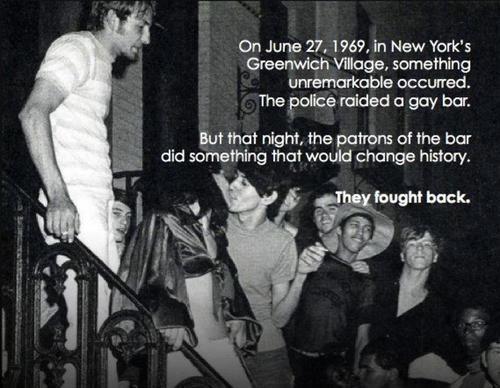
For a little walk in (again, a dramatized one) history, we offer Stonewall (1995, Nigel Finch). While it has 1990's written all over and sometimes makes you cringe because of awkwardness, it's still worth the while.

Playing with the idea that every LGBTQI activist has their own Stonewall story (yes, yes, go, read the wiki, we'll wait), so here you have one particular story with all the dramatic ingredients and dichotomies you wanted. Being out / being in closet. Trying to fit in / defying. Creating closed ghettos / suffering discrimination. Different ways of doing activism. Love. Friendship. Corrupt policemen. Street riots. Some jail. Lots of the Shangri-Las and lip-sync. Reminder that the most famous LGBTQI riot (and historical milestone) was fought by trans persons of color and not well-groomed rich white men.
Don't expect much from this, and you might be surprised.


27 December 2013

Friday is the (Inspirational) Movie Night: La vie d'Adèle (2013)

#inspirationalmovies


La vie d'Adèle or Blue is the Warmest Color (2013, Abdellatif Kechiche) is a heavy romantic French drama, a very good example of cinematic depiction of the realities of making and unmaking affective relationships. And being French, it's explicitly sexual (take care of this, think twice before watching this with your grandma...), full of intense emotions, intimate details, ups and downs characteristics of the life in couple.

The twist away from the typical emotionally charged romantic drama is the fact that the central couple is made of two young women. Therefore, the already existing tension of desire, negotiations, jealousy, changing feelings is accompanied with additional pain caused by coming out, stigma, construction of an alternative identity and other little gifts that the heteronormative patriarchy brings.

Go, block 3 hours (!) of your busy schedule to immerse yourself in what is already becoming a classic of LGBTQI movies. And then feel free to read some of the analysis already done on the possible bias introduced by the male gaze and stereotyping, etc. Some people think it's more of the same old eroticizing for hetero audiences, some claim it as a step out of this girls just playing dogma... Go, make up your mind.